Last updated 2026-08-18
TL;DR
To start livestock hauling in Arkansas you need a commercial driver's license, a USDOT number, a motor carrier authority (MC number) if crossing state lines, and knowledge of Arkansas's intrastate exemptions. Budget $4,000-$10,000 for papers, insurance, and first-year compliance. Timeline is 4-8 weeks if you chase the right forms from day one.
Do you need a license for livestock hauler in Arkansas?
Yes. You need a commercial driver's license (CDL) if your truck and trailer combination has a gross vehicle weight rating (GVWR) of 26,001 pounds or more, or if you haul livestock in a vehicle designed to transport 16 or more passengers including the driver. Most livestock haulers run a one-ton pickup and gooseneck trailer that exceeds 26,001 pounds combined GVWR, which flips you into CDL class A territory.
Arkansas issues CDLs through the Department of Finance and Administration, Office of Driver Services. Federal rules say a CDL is required when the combination vehicle's GVWR is 26,001 pounds or more and the trailer's GVWR is over 10,000 pounds [1]. Arkansas law mirrors that exactly under Ark. Code Ann. § 27-23-109 [2].
There is a farm exemption many people get wrong. You can drive a combination vehicle without a CDL if you operate it for a farm and you stay within 150 miles of the farm. The exemption covers the farmer or a family member or an employee, and the vehicle must be registered with farm plates. But it does not cover a for-hire livestock hauler carrying someone else's cattle for money. If someone pays you to haul, the exemption disappears. If you get caught, it is a state court date, not a warning.
For-hire authority is a different piece of paper from the CDL. If you haul livestock for someone else across state lines, you need a USDOT number and operating authority from the Federal Motor Carrier Safety Administration, specifically an MC number [3]. If you run strictly inside Arkansas, state rules apply. We cover that next.
Do you need a USDOT number or MC authority for livestock hauling in Arkansas?
A USDOT number is required for any commercial vehicle over 10,001 pounds GVWR that crosses state lines. Livestock haulers almost always run over that weight. You get a USDOT number free from the FMCSA registration site [4]. It takes about 20 minutes if you have your business name, EIN, and vehicle details ready.
An MC number (operating authority) is the paid piece. If you haul livestock for hire across state lines, you need MC authority. That application cost $300 as of 2026, and you must also file proof of insurance before it activates [5]. The FMCSA shows current fees on the registration site, but the $300 figure has held steady for several years.
Arkansas has a notable wrinkle for intrastate haulers. If you only move livestock within Arkansas and never cross a state line, you do not need MC authority. You still need the USDOT number if your vehicle's GVWR is over 10,001 pounds, unless you qualify for the farm vehicle exemption. Arkansas does not have a separate intrastate livestock hauler permit like some states do. The state relies on the federal registration plus state fuel tax and registration [6].
What you can skip: an Arkansas intrastate operating authority. The state does not issue one for property carriers. This trips up people coming from Texas or California who expect a state-specific permit. Arkansas keeps it simple: federal DOT number, CDL if over weight threshold, and the insurance filings through FMCSA handle the carrier authority.
What CDL class and endorsements do livestock haulers need in Arkansas?
Class A CDL if your combined GVWR is 26,001 pounds or more and the trailer's GVWR is over 10,000 pounds [1]. That covers essentially every gooseneck stock trailer behind a one-ton or heavier truck. If you somehow run a truck under 26,000 pounds with a lighter trailer, a Class B or even a Class D license might cover it, but that is rare in actual livestock work.
You do not need a hazardous materials endorsement for livestock. You do not need a tanker endorsement for a standard stock trailer. You do not need a doubles/triples endorsement unless you intend to pull more than one trailer. If you plan to haul horses for hire to shows, no passenger endorsement applies; livestock in a trailer are cargo, not passengers under the CDL definitions [7].
The CDL skills test in Arkansas has a pre-trip inspection, basic controls, and road test. You must hold a commercial learner's permit for 14 days before the road test, by state rule [8]. Realistically, if you are starting from zero, plan 3 to 6 weeks to get through written tests, the learner's permit wait, skills practice, and the road test. Arkansas does not require formal truck driving school to take the test, though a week with an instructor is money well spent if you have never backed a gooseneck stock trailer into a chute.
How much does livestock hauler cost in Arkansas?
First-year cost to start a one-truck for-hire livestock operation in Arkansas runs roughly $4,000 to $10,000, before you buy a truck or trailer. Most of that is insurance. Here is the real breakdown.
CDL costs: permit fee about $20, license fee about $42 for a four-year CDL, medical exam $80 to $150, and a DOT physical is mandatory before you take the skills test [9]. Truck driving school is optional, but if you pay for one week of gooseneck training, figure $500 to $1,500.
USDOT number is free. MC authority application is $300 one-time [5]. No annual renewal fee on the MC number itself, but you update your information every two years or face civil penalties.
Insurance is the big line item. Primary liability insurance for a livestock hauler with MC authority requires $750,000 minimum coverage [10]. Annual premium for a new authority, one truck, livestock cargo: $6,000 to $12,000. Some insurers charge more for livestock than general freight because animals shift, and a tipped-over trailer full of cattle is expensive. Cargo insurance for livestock is optional but if a load of 30 bred heifers dies in a summer breakdown, the loss is hers and yours. Cargo coverage of $50,000 to $100,000 might add $1,000 to $2,500 a year.
BOC-3 filing agent costs $25 to $75 one-time, but you have to buy it through a process agent company [11]. Arkansas IFTA fuel tax permits are free if you register through the state, though you owe fuel tax quarterly once you cross state lines [6].
What you can skip: apportioned registration (IRP) if you stay inside Arkansas only. The moment you haul one load over to Texarkana, Missouri, or Memphis, you need IRP plates. Arkansas IRP fees vary by mileage and vehicle weight, commonly $600 to $1,800 a year for a one truck operation, but the state calculates it from your actual prior year miles [12]. Nobody can honestly quote that number without your exact route history; confirm with the Arkansas IRP office.
How long does livestock hauler take in Arkansas?
Realistic timeline from zero to first paying load: 4 to 8 weeks, if you file everything in the right order and nothing gets rejected. Here is the sequence that avoids the usual FMCSA hold times.
Week 1: get your business entity and EIN if you do not have one. Arkansas LLC filing through the Secretary of State runs online and is usually approved in 1 to 3 business days [13]. Open a business bank account the same week.
Week 1-2: apply for the USDOT number online. This is instant if you have no flags. Simultaneously submit the MC authority application. FMCSA processing for MC authority activation is 20 to 25 business days after you pay, and that clock only starts once your proof of insurance is on file [5]. So line up insurance in week 1, not week 4.
Weeks 2-4: CDL testing. You need the commercial learner's permit first, then a 14-day wait in Arkansas before the road test [8]. Book your road test date the same day you get the permit, because test slots in little county trooper stations fill up fast.
Weeks 4-6: insurance binder, BOC-3 filing, and MC activation. Your MC number goes active roughly three weeks after FMCSA sees your insurance proof. You cannot legally haul for hire across state lines until the MC number shows active on the SAFER database.
Weeks 6-8: register for IFTA if you cross state lines, get IRP plates if needed, buy a cheap pre-trip inspection checklist, and start taking loads. Total end-to-end, with no rejections and cooperative state offices, is about two months. If you file insurance late, add three weeks. If you fail the CDL road test, add one to three weeks for a retest slot.
What Arkansas-specific registrations apply to livestock haulers?
Beyond the federal papers, Arkansas requires two or three state items depending on your routes. First, vehicle registration through the Department of Finance and Administration's Office of Motor Vehicle. If you run farm plates, you do not pay most ad valorem taxes but you cannot haul for hire. For for-hire commercial use, you need commercial tags and you pay personal property tax annually [14].
Second, intrastate fuel tax. If all your miles stay inside Arkansas, you just pay at the pump. The moment you cross into Oklahoma, Texas, Missouri, Louisiana, Mississippi, or Tennessee with a commercial truck, you need an IFTA permit. Arkansas issues IFTA licenses at no cost from the state revenue office [6]. You file quarterly fuel tax returns, and IFTA handles the apportioned tax between states.
Third, IRP apportioned registration if you run interstate. Arkansas IRP registration is administered by the Arkansas Department of Finance and Administration. It calculates annual fees based on miles in each state and vehicle weight [12]. If you only do one or two out-of-state loads a year, some haulers weigh whether IRP is worth it for a month of use. But legally, any interstate commercial haul with a vehicle over 26,000 pounds requires IRP. There is no 'occasional haul' exception under 30 days in Arkansas; some states have it, Arkansas does not.
One Arkansas curiosity: the state does not charge a separate livestock hauler inspection fee or brand inspection fee for in-state cattle movement. Brand inspection is a western states thing. Arkansas has a brand registry under the Arkansas Livestock and Poultry Commission, but you do not need brand paperwork to haul cattle inside the state [15]. If you haul to Texas or Oklahoma, those states have their own requirements on the receiving end.
What insurance do Arkansas livestock haulers legally need?
One number matters above all: $750,000 minimum primary liability for a for-hire motor carrier with MC authority [10]. That is federal, not Arkansas-specific. If you haul only intrastate, Arkansas does not lower that number for commercial haulers; it relies on the federal floor. In practice, most livestock haulers buy $1 million primary liability, because every sale barn, feedlot, and meat plant that hires a new truck checks for $1 million and declines to work with $750,000 carriers.
Cargo insurance for livestock is not required by law. The question is whether you can afford a $40,000 loss if a trailer tips and the animals die or run loose. Brokers and direct shippers often require $100,000 cargo coverage before they will load you. Expect to prove both coverages on a certificate of insurance before your first load [3].
Physical damage insurance on the truck and trailer is also not required by law, but if you financed the truck, your lender requires it. And livestock trailers depreciate hard; a 10-year-old Wilson or Merritt aluminum stock trailer still sells for $18,000 to $30,000, so self-insuring a total loss is a bad idea.
A real annual budget for new livestock hauler insurance: $8,000 to $15,000 for one truck, good driving record, for-hire authority, $1 million liability, $100,000 livestock cargo, no physical damage. Rates drop after three claim-free years. Some Arkansas agents write farm-adjacent policies cheaper, but if the policy says farm use and you get inspected while hauling for hire at a sale barn, the claim gets denied. Buy a for-hire commercial policy from day one.
What equipment do you need to start livestock hauling in Arkansas?
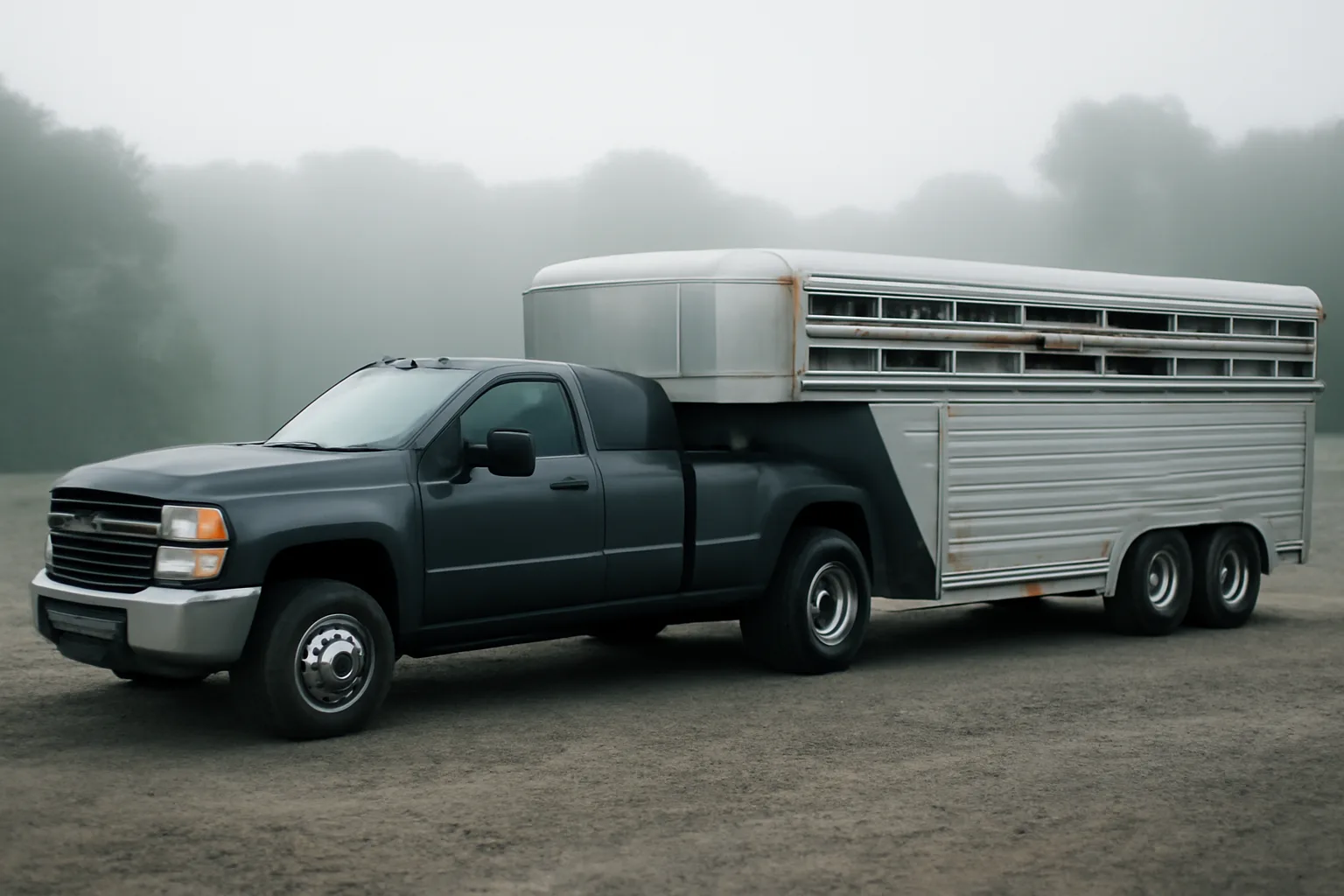
Minimum viable setup in Arkansas is a one-ton dually diesel pickup and a gooseneck stock trailer. The truck needs: legal GVWR that puts you over 26,001 pounds combined, towing capacity for a loaded trailer (figure 12,000 to 18,000 pounds loaded), and a gooseneck hitch rated for at least 25,000 pounds. A Ford F-350 or F-450, Chevy 3500, or Ram 3500 dually is the standard.
The trailer matters more than the truck for livestock. Buy a trailer with a center gate and rear gate, cut gates for sorting, interior lights, and a rubber floor. Aluminum trailers like Wilson, Merritt, Sooner, and Eby hold value and tow lighter than steel. A 24- to 32-foot aluminum gooseneck stock trailer costs $22,000 to $45,000 used, $35,000 to $65,000 new [16]. Steel trailers run $12,000 to $25,000 used but rust out faster in humid Arkansas summers with cattle manure sitting on the floor.
Skip the living quarters package. Skip the hydraulic lift. Skip custom paint. A livestock hauler making money runs the most boring stock trailer at the sale barn, not the prettiest one.
Essential accessories: a heavy-duty anti-sway weight distribution system (about $400 to $1,000), a backup camera ($150 to $300), a livestock first aid kit, a tire plug kit, two spare tires mounted, and a 30-foot chute gate extension. You also need a portable corral panel or two for unloading emergencies. Budget $3,000 to $6,000 beyond the truck and trailer for these.
How do you find livestock hauling loads in Arkansas?
The best first loads in Arkansas come from three places: sale barns, direct producer relationships, and livestock hauling dispatchers. Sale barns are a specific type. Every town in Arkansas with more than 2,000 people has a weekly cattle sale, and the barn manager knows which trucks are reliable and which ones show up late. Show up on sale day, introduce yourself, ask who handles their overflow loads. Expect to haul cheap local runs for six months before barns trust you with high-value loads.
Direct producers are slower but pay better. Arkansas has roughly 1.6 million head of cattle, mostly beef cows on small farms [17]. A hauler who can back a trailer into a muddy pasture gate without leaving ruts and who shows up when promised gets repeat work from ranchers moving calves to sale, moving cows to new pasture, or hauling to slaughter. These loads often pay cash and require no broker.
Livestock load boards like HaulHound, CattleRange, and the old standby DAT have livestock categories, but the best-paying loads are not posted. They are phone calls. A broker might call you for a load from the Little Rock sale barn to a feedlot in the Texas Panhandle, and that load pays $2.50 to $3.50 a loaded mile [18]. Local Arkansas runs of 50 to 150 miles might pay $2 to $3 a loaded mile.
Rates vary hard by season. Spring calf runs in Arkansas start in March and peak in April and May, and everyone with a trailer is busy. Late summer is slow, and fall runs pick up in October. Nobody publishes official Arkansas livestock hauling rate tables; the truth is that rates are set by phone calls, relationships, and a hauler's reputation for not killing loads.
What are the common Arkansas livestock hauler mistakes?
Mistake one is thinking the farm exemption covers for-hire hauling. It does not. If you get stopped by Arkansas Highway Police with a paid load of sale barn calves and no CDL, no USDOT number, and farm plates, the fine is real and the trailer sits until you sort it out.
Mistake two is filing for MC authority before you have insurance lined up. FMCSA will not activate the MC number until insurance is on file, and the application fee is not refundable. Get an insurance quote in hand before you file.
Mistake three is buying a truck and trailer before you have the CDL and the MC number. Paying for a $70,000 rig that sits in the driveway for eight weeks while you wait on the road test and FMCSA activation is bad math. The smart sequence: get the CDL first, get the authority second, buy the truck third.
Mistake four is ignoring weight. A one-ton dually with a loaded 32-foot stock trailer can easily run 28,000 pounds combined. That is over the 26,001 pound CDL threshold, which is fine if you have a CDL, but it also puts you in Arkansas oversize or overweight territory if your axle weights exceed state limits. Arkansas state highway weight limits are 80,000 pounds gross, 20,000 pounds single axle, 34,000 pounds tandem axle [19]. Most livestock trailers do not approach that, but a heavy steel trailer with 15 grown cows can hit the rear axle limit if loaded poorly.
Mistake five is thinking cargo insurance is optional in practice. It is legally optional, until a June heat wave kills $60,000 of someone's registered Angus herd. Then it is not optional, it is the difference between a lawsuit and a claim.
What does the first 90 days of Arkansas livestock hauling look like?
First 90 days is paperwork, cheap loads, and repeated learning. You will make less than minimum wage some weeks. That is honest. A new livestock hauler with one truck in Arkansas can expect to gross $4,000 to $8,000 a month after insurance and fuel, but the first two months may come in below that while you build a reputation [18].
Your days start before dawn for sale barn runs. You load at 5 or 6 a.m., run 100 to 200 miles, unload, and deadhead home. A single loaded run at $2.50 a mile for 150 miles is $375 gross. Fuel at 8 mpg and $3.50 diesel is about $65. Insurance daily cost at $10,000 a year is about $27. Maintenance accrual is another $15 to $25 a day. You net about $200 to $250 a day before you pay yourself. That is the real math for a new hauler.
You will spend 20% of your time on compliance: quarterly IFTA filings if you cross state lines, updating your USDOT information every two years, annual medical cards, random drug and alcohol testing if you run interstate (FMCSA requires enrollment in a consortium testing pool [20]), and keeping a pre-trip log. If you hate paperwork, livestock hauling is not for you.
The haulers who last in Arkansas are the ones who show up on time, load cattle quietly, check tires at every stop, and never cancel on a producer at 5 a.m. because the truck was not maintained. The work is not hard to find. The work is hard to keep.
Step-by-step Arkansas livestock hauler checklist
Here is the actual list, in order. Print it.
1. Get a DOT physical from a certified medical examiner and the medical card. You need this before the CDL permit. 2. Get your Arkansas commercial learner's permit at a state troop testing location. Study the Arkansas CDL manual, free on the DFA website. 3. Wait 14 days, then pass the CDL skills test. You can rent a truck and trailer from a driving school if you do not own one yet. 4. File for your USDOT number online at the FMCSA registration portal. It is free and instant. 5. File for MC authority if you haul interstate for hire. Pay the $300 application fee. 6. Get insurance: $1 million primary liability recommended, $100,000 livestock cargo recommended. File proof with FMCSA. 7. File a BOC-3 with a process agent service. This is a federal requirement for MC carriers [11]. 8. Register for IFTA with Arkansas if you plan to cross state lines. Free to register, quarterly filings required. 9. Get IRP apportioned plates if you run interstate. 10. Buy the truck and trailer, get commercial registration and plates, and start taking loads.
Skip any step and the process stalls. The order matters because CDL testing does not wait on FMCSA, and FMCSA activation does not wait on CDL testing. Run steps 1 through 4 in parallel where you can.
Arkansas livestock hauler costs vs. neighboring states
Arkansas is one of the cheaper states to start a livestock hauler because it does not add a state-specific carrier fee on top of the federal ones. Texas and Oklahoma both have additional state registration costs. Tennessee has a state business license requirement. Arkansas just wants your federal papers, commercial plates, and fuel tax if you cross state lines [6].
Here is the numbered comparison, all figures for one-truck for-hire interstate livestock operation.
| State | State-specific permit | CDL fee | MC authority | Typical first-year cost (excl. truck/trailer) |
|---|---|---|---|---|
| Arkansas | None | $42 | $300 | $8,000-$15,000 |
| Texas | Texas intrastate authority (if applicable) | $45 | $300 | $8,500-$16,000 |
| Tennessee | State business license, local permits | $44 | $300 | $8,000-$16,000 |
| Missouri | No state permit | $43 | $300 | $8,000-$15,000 |
The cost range mostly reflects insurance. New authority livestock insurance runs higher than general freight because animal cargo moves and tips [10]. Arkansas's advantage is not a cheaper piece of paper; it is that there is no piece of paper at the state level to buy.
Should you use a DOT compliance service or kit?
A compliance kit is genuinely useful for one reason: FMCSA rejection letters are the number one avoidable delay for new Arkansas livestock haulers. The USDOT number application asks for a lot of specifics, and a mistake on vehicle classification or business name sends it back. A $149 one-time USDA/DOT kit that gives you the checklist, the BOC-3 filing route, and the exact insurance form names is cheap insurance against a four-week delay. You can find the same information free by reading FMCSA's FAQ pages for 10 hours. StockHaulPath sells a USDA/DOT + COI kit for $149; whether that is worth it depends on how fast you need the authority activated and how much you enjoy federal paperwork.
What you should not do is pay anyone a monthly fee for 'compliance management' as a one-truck livestock hauler. You file IFTA quarterly and update USDOT every two years. That is 15 minutes a quarter. A monthly compliance service for $75 to $150 a month is wasted money unless you run five or more trucks.
The livestock hauler license arkansas guide lays out the exact forms with direct links and walks through common FMCSA hold reasons. If your MC application stalls, that page is the fastest reference.
What if you only haul your own livestock in Arkansas?
The rules change sharply if you are a producer hauling your own cattle. You do not need a CDL if the combined GVWR is under 26,001 pounds. You do not need a USDOT number if you stay within 150 miles of your farm and the truck has farm plates [2]. You do not need MC authority if you never haul for hire.
But the moment someone gives you $200 to pick up their calves from the sale barn, you are a for-hire carrier. The farm exemption vanishes. The insurance policy you wrote for farm use has a clause that excludes for-hire hauling. If you wreck while hauling someone else's cattle on a farm policy, the claim is denied and the cattle owner sues you.
Many Arkansas part-time livestock haulers start this way: they buy a one-ton and stock trailer for their own cows, and the neighbors start asking for hauling. The honest route is to decide before that first paid load. Either get the CDL, USDOT number, and commercial insurance, or say no. Half-measures are where the legal pain starts.
Frequently asked questions
Do I need a CDL to haul livestock in Arkansas?
Yes, if your truck and trailer combination has a GVWR of 26,001 pounds or more. A one-ton dually and gooseneck stock trailer almost always exceeds that. The farm exemption covers your own farming operation within 150 miles of the farm, but not for-hire hauling for payment.
How much does a livestock hauler license cost in Arkansas?
A CDL costs about $62 total for permit and four-year license, plus $80 to $150 for the DOT medical exam. The USDOT number is free. MC authority application cost is $300 if you haul interstate for hire. No other Arkansas-specific license fee applies.
How long does it take to start livestock hauling in Arkansas?
Four to eight weeks realistic. CDL permit to road test has a 14-day wait, and MC authority takes 20 to 25 business days after insurance proof is filed. If you file paperwork in parallel and pass the road test first try, eight weeks is common.
Do I need USDOT number for intrastate livestock hauling in Arkansas?
Yes, if your vehicle's GVWR is over 10,001 pounds, even if you stay inside Arkansas, unless you qualify for the farm vehicle exemption. For-hire carriers need the USDOT number regardless of distance.
Can I haul livestock without commercial insurance in Arkansas?
No for for-hire hauling. Federal rules require $750,000 minimum primary liability for MC carriers, and Arkansas relies on that standard. Without a for-hire commercial policy, any claim while hauling for pay gets denied.
What is the difference between USDOT and MC number?
A USDOT number identifies the carrier for safety tracking. An MC number is operating authority that lets you haul for hire across state lines. You need both for interstate livestock hauling. Intrastate only requires the USDOT number.
Does Arkansas require brand inspection for cattle being hauled?
No. Brand inspection is a western states requirement. Arkansas has a brand registry but no brand inspection requirement for in-state cattle movement. Receiving states like Texas or Oklahoma may have their own requirements.
Is truck driving school required for CDL in Arkansas?
No. Arkansas allows self-study and testing without formal school. But if you have never backed a gooseneck stock trailer, a week of professional training costs $500 to $1,500 and cuts your test failure risk.
What kind of truck do I need for livestock hauling?
A one-ton dually diesel pickup is the minimum for real livestock work. Ford F-350/F-450, Chevy 3500, or Ram 3500. Combined GVWR with a loaded stock trailer puts you over 26,001 pounds, which is why CDL class A is required.
How much can a livestock hauler make in Arkansas?
New one-truck operators gross $4,000 to $8,000 a month after insurance and fuel, with the first two months often below that. Loaded rates run $2.50 to $3.50 a mile for long hauls, $2 to $3 a mile for local runs. Net pay depends hard on your insurance rate and deadhead percentage.
Do I need IFTA for livestock hauling in Arkansas?
Only if you cross state lines. Arkansas IFTA registration is free. Once registered, you file quarterly fuel tax reports and the state apportions taxes with other states. Purely intrastate haulers just pay at the pump.
What is BOC-3 and do livestock haulers need it?
BOC-3 is a designation of process agents in every state where you operate. Every MC carrier needs it. It costs $25 to $75 through a process agent service and must be filed before your MC authority activates.
Can I haul livestock across state lines with an Arkansas CDL?
Yes. An Arkansas CDL is valid in all states, but you also need MC authority, IFTA, and IRP registration to legally run interstate for hire. The CDL alone does not grant hauling authority.
What is the weight limit for livestock trailers in Arkansas?
State highway limits are 80,000 pounds gross, 20,000 pounds single axle, 34,000 pounds tandem axle. Most livestock trailers run far under that, but a poorly loaded steel trailer with 15 heavy cows can approach rear axle limits.
Sources
- FMCSA, CDL classification: CDL Class A required when combination GVWR is 26,001 pounds or more and trailer GVWR exceeds 10,000 pounds
- Arkansas Code § 27-23-109: Arkansas requires CDL for vehicles over 26,001 pounds and has farm vehicle exemptions within 150 miles
- FMCSA, Get Operating Authority: MC number required for for-hire interstate carriers; USDOT number required for commercial vehicles over 10,001 pounds
- FMCSA, USDOT Number Registration: USDOT number application is free and online
- FMCSA, Operating Authority Fees: MC authority application fee is $300 one-time
- FMCSA, CDL Endorsements: Livestock in a trailer are cargo, not passengers requiring passenger endorsement
- FMCSA, Minimum Insurance Requirements: For-hire motor carriers require $750,000 minimum primary liability insurance
- FMCSA, BOC-3 Filing: BOC-3 process agent designation required for all MC carriers
- Arkansas Secretary of State, Business Filing: Arkansas LLC online filing approved in 1 to 3 business days
- FMCSA, Drug and Alcohol Testing: Interstate commercial carriers enrolled in a random drug and alcohol testing consortium