Last updated 2026-08-18
TL;DR
You start with a CHP CA number and a DMV Motor Carrier Permit. Add a USDOT number if you cross state lines. Budget a few hundred dollars for the state paper stack, not counting the truck. A clean California filing usually takes two to six weeks. Confirm current DMV and CHP fees before you budget.
Do you need a license for livestock hauler in California?
Yes. California has no separate livestock hauler license. You run under the same motor carrier rules as any for-hire property carrier. The core state paper is a CHP CA number and a DMV Motor Carrier Permit (MCP) [1][2]. If the truck and loaded trailer combination has a gross vehicle weight rating over 26,000 pounds and the trailer is over 10,000 pounds, the driver also needs a commercial driver license, usually Class A [5]. California Vehicle Code section 34620 states: "a motor carrier shall not operate a commercial motor vehicle on any public highway in this state unless the motor carrier has obtained from the department a motor carrier permit" [2]. That is the statutory gate.
A lot of first-time operators think livestock hauling is an agricultural exemption. It is not. California regulates most for-hire commercial vehicles over 10,001 pounds GVWR regardless of the commodity [3]. If you cross a state line, add a USDOT number and probably Unified Carrier Registration [4][10]. Animal movement papers are separate regulatory documents, not a hauler license. Start with the state permit stack, then deal with the animal side. A longer explainer lives at Livestock hauler license in California: the real paper path.
What weight triggers a California livestock hauler CDL and CA number?
Use 10,001 pounds and 26,000 pounds as your two gates. A CA number applies to most commercial motor vehicles with a gross vehicle weight rating over 10,001 pounds operated in California [3]. The USDOT number for interstate property hauling kicks in at the same 10,001-pound threshold [4]. Class A CDL comes in when the whole combination is over 26,000 pounds and the trailer is over 10,000 pounds [5]. The stickers matter, not that morning's scale ticket.
CHP can use the manufacturer's GVWR stickers to decide whether you need a CDL or a CA number, even if the trailer is empty. A one-ton dually rated at 14,000 plus a 14,000 stock trailer is a 28,000 combination, above the CDL line. Many gooseneck setups cross that line. Check the stickers before you buy. If you stay under 26,000 combined GVWR and the trailer is 10,000 or less, a Class C plus a medical certificate may work. But many commercial stock trailers are rated over 10,000, so plan for Class A.
How much does livestock hauler cost in California?
The honest answer is that California has no single livestock hauler cost line. The California-specific permit stack is the cheapest part of the business. A USDOT number is free when you register directly with FMCSA [4]. The MCP and CA number are standard motor carrier fees, not livestock-premium fees; confirm current amounts on the DMV MCP page and CHP CA Number page because both change [1][3]. Plan a few hundred dollars for the state stack.
The expensive pieces are insurance and the truck. Federal rules set the liability floor at $750,000 for most for-hire property carriers with vehicles over 10,001 pounds [6]. Livestock is property under that rule. Policy quotes vary by radius, record, and whether you haul for hire or your own animals. Get three quotes before you lock a budget. A Texas comparison at How to start a livestock hauler business in Texas and Livestock hauler cost in Texas shows the same pattern with different state fees. If you want one packet instead of ten bookmarks, StockHaulPath sells a $149 one-time USDA/DOT + COI Kit at /start, but the underlying forms are free.
How long does livestock hauler take in California?
Plan two to six weeks for the California-side filings when your file is clean. FMCSA issues a USDOT number online immediately after you complete registration [4]. The CHP CA number may move faster or slower depending on inspection and mail volume; CHP does not guarantee a date [3]. The DMV MCP can add weeks because it goes through the carrier office, not a local DMV field office appointment [1]. Brand inspection and movement permits are per load or per movement, usually arranged same day to a few days before loading [8].
Do not book the first paying load until the CA number, MCP, and insurance filing show active. Carriers lose time when they get the USDOT number, book a load, and only then learn the MCP needs the insurance certificate on file. A Texas timeline comparison is at Livestock hauler license in Texas: the real paper path.
Which agency issues the CA number and MCP in California?
CHP issues the CA number through its Motor Carrier Safety Unit. DMV issues the MCP. They are separate applications, separate renewals, and separate lookups, but they work together. CHP enforces commercial vehicle rules, inspects terminals, and can take a carrier out of service for no CA number [3][11]. DMV keeps the MCP and the insurance filing on record [1]. A field office clerk usually cannot fully process the MCP; it runs through Sacramento or online.
For livestock, CDFA adds a third state stop for animal movement and brand inspection [8][9]. Keep one sheet with CA number, MCP activation date, USDOT number, and the local brand inspector's phone number. At a checkpoint, that sheet saves twenty minutes.
Do I need a USDOT number for intrastate California livestock hauling?
No, if you never cross a state line and stay within California, a USDOT number is not required under federal intrastate rules. You still need the CA number and MCP [1][3]. But many California livestock routes hit Nevada, Oregon, or Arizona for sales, feedlots, or processing. If any part of the trip crosses a state line, the USDOT number applies at the 10,001-pound combined GVWR threshold [4]. Interstate also triggers Unified Carrier Registration annually [10]. If Arizona is your main out-of-state point, see How to start livestock hauler in Arizona. When unsure, register for the USDOT number anyway. It is free and keeps port-of-entry questions short.
What California brand inspection and movement papers apply to livestock haulers?
California requires brand inspection for cattle moving out of brand inspection areas, to sale, out of state, and on most ownership changes [8]. CDFA's Bureau of Livestock Identification issues those certificates. The hauler can be held responsible for a load without a brand inspection certificate, even when the shipper said it was handled. Movement permits from CDFA's Animal Health Branch cover entry requirements and some within-state disease-control moves [9]. Horse-only hauls often skip brand inspection, but entry requirements can still apply.
The practical order is: animal health entry permit if moving into or out of state, brand inspection before loading, and the signed certificate rides with the driver. The federal 28-hour law also applies to livestock on long trips. It requires unloading for feed, water, and rest after 28 consecutive hours [7]. Keep a written log of load and rest times, even if your logbook class does not require it, because livestock enforcement looks at the animal's condition.
What insurance does a California livestock hauler need?
At minimum, a for-hire livestock hauler with a truck over 10,001 pounds needs $750,000 in motor carrier liability coverage [6]. The CFR rule says the minimum level for property is $750,000 for vehicles at 10,001 pounds or more. Livestock is property, not hazardous material, under that section. Cargo coverage for death, heat stress, or injury is a separate product. A farm auto policy often will not cover for-hire interstate movement. Find an agent who writes motor carrier policies.
DMV must have the insurance certificate on file for the MCP. If the policy lapses, the MCP can be suspended [1]. Put a renewal reminder at 45 days out. The certificate is part of the paper path, not a one-time startup step.
What truck and trailer setup works for California livestock hauling?
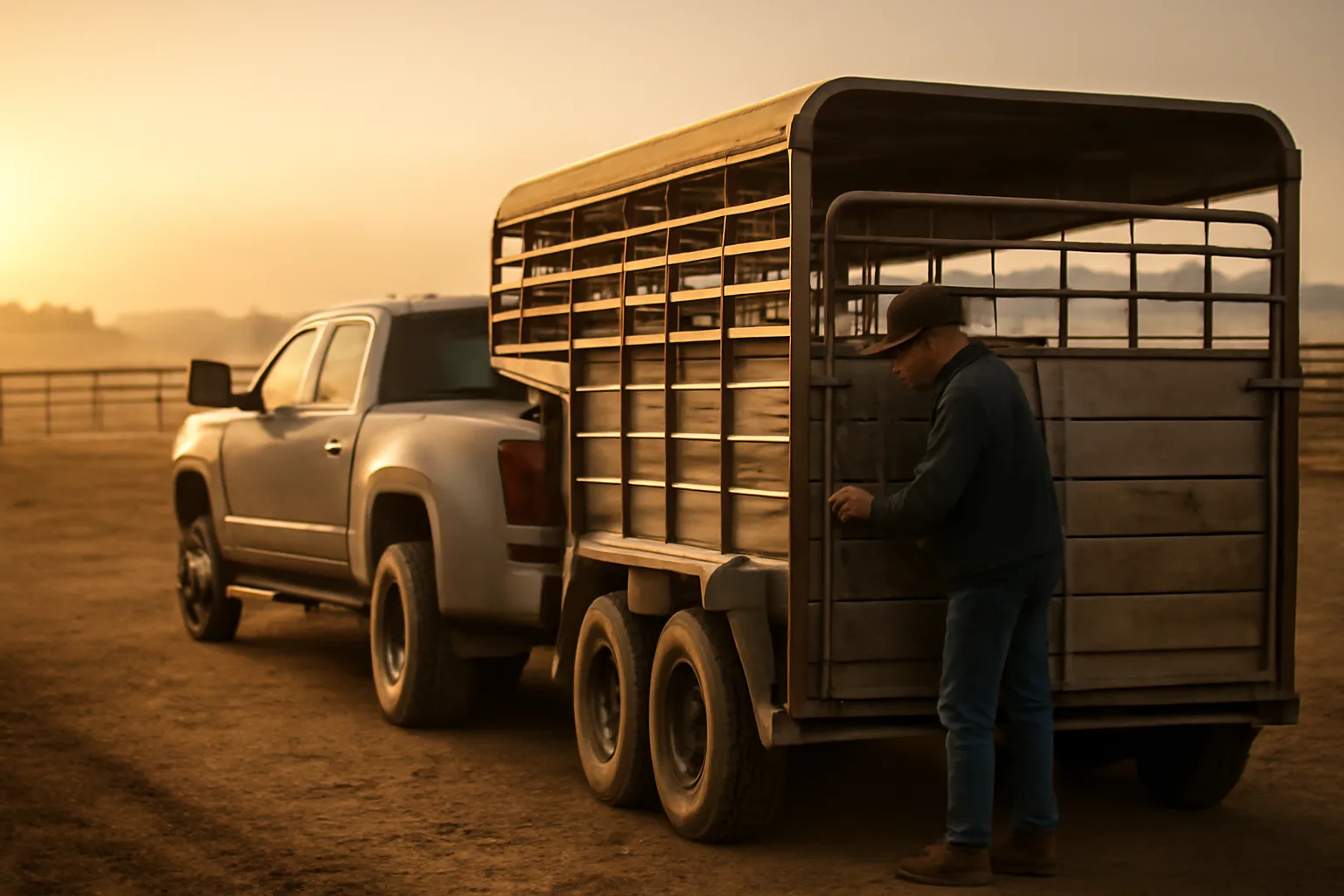
For one-person commercial work, the common California setup is a one-ton dually with a gooseneck stock trailer or a small straight truck with a stock box. The state does not care about brand; the CHP inspection checks brakes, lights, tires, suspension, and the GVWR stickers [11]. The combined GVWR decides your license. Many gooseneck trailers are 14,000 or 16,000 GVWR. Add a 14,000 truck and you are over the 26,000 CDL line. That pushes you to Class A plus the medical certificate.
A 10,000 trailer and a 10,000 truck can keep you under the CDL line, but capacity drops fast. Choose the setup by the real weights of the cattle and the route. A trailer full of mature cows weighs more than a few calves. Know the axle ratings and do not trust a salesman's verbal 'you'll be fine'.
What kills a California livestock hauler application?
The three most common killers are missing insurance filings, wrong weight class, and moving animals before brand inspection. DMV and CHP do not waive them because a load is waiting. The other common mistake is underestimating the CDL. A regular Class C with a big stock trailer can earn an out-of-service order at a commercial inspection. The MCP application is short, but the carrier can be denied if the terminal inspection fails under CVC 34500 rules [11]. Keep the terminal address real, keep maintenance records, and do not hide a second truck. California's carrier office checks.
The $149 paper kit and the free path
The FMCSA, CHP, DMV, and CDFA publish their forms free. No state office sells a livestock hauler kit, and no third-party packet files for you. StockHaulPath sells a $149 one-time USDA/DOT + COI Kit at /start. I would use it only as a checklist if you want one binder. The same blanks exist free on the agency pages. The real path is the same whether you spend $149 or nothing: get the numbers, file the insurance, get the animal papers, and build repeatable loads. If you want the Texas version of this walkthrough, Livestock hauler cost in Texas: licenses, fees, and startup expenses has the same structure.
Frequently asked questions
Do you need a license for livestock hauler in California?
Yes, but not a separate livestock license. You need a CA number from CHP, a Motor Carrier Permit from DMV, and, if the combined GVWR is over 26,000 with trailer over 10,000, a CDL. A USDOT number applies if crossing state lines. California has no standalone livestock hauler permit; it is motor carrier authority plus animal movement papers.
How much does livestock hauler cost in California?
The permit stack is a few hundred dollars, not thousands. USDOT number online is free. MCP and CA number fees are standard state fees, confirmed on DMV and CHP pages. Big money is insurance. Federal liability floor is $750,000 for for-hire property over 10,001 pounds; policy quotes vary. Truck and trailer make up most startup cost.
How long does livestock hauler take in California?
Plan two to six weeks for CA number and MCP after filing. FMCSA gives USDOT immediately online. Per-load brand inspection and entry permits are often same day but must be arranged before loading. No state guarantee exists; call DMV and CHP to confirm your file.
What is the difference between a CA number and a USDOT number for livestock hauling?
CA number is California's intrastate carrier identifier from CHP. USDOT number is federal and required for interstate travel at 10,001-pound GVWR. Both can appear on the same door. A CA-only livestock hauler does not need USDOT. Cross a state line, add USDOT and UCR.
Can I haul livestock with a regular Class C license in California?
Yes, if your truck plus loaded trailer combination has a GVWR of 26,000 or less and the trailer is 10,000 or less. Many stock trailers exceed 10,000 GVWR, so the Class A CDL becomes required. Check both GVWR stickers. You also need a valid medical certificate if operating commercially.
Do I need brand inspection to haul cattle in California?
Most cattle moves out of a brand area, to sale, or out of state require CDFA brand inspection before loading. The certificate rides with the driver. Horses may not need brand inspection, but animal health entry rules still apply for some moves. Always call the brand inspector, more than the shipper.
Is insurance required before I can get an MCP in California?
Yes. DMV requires evidence of insurance, usually a certificate on file. For for-hire property carriers over 10,001 GVWR, the minimum liability is $750,000. If insurance lapses, the MCP can be suspended. Cargo coverage for lost livestock is separate.
Does the 28-hour law apply to California livestock haulers?
Yes, federal law requires that livestock cannot be confined for over 28 consecutive hours without unloading for food, water, and rest. There are time-limited exceptions for owner request. The clock runs on interstate and many intrastate long hauls. Keep a written log of load and rest times.
Can I use a pickup and gooseneck to haul livestock for hire in California?
Yes, if the combination meets state and federal rules for the weights involved and you carry the right license and permits. A one-ton dually with a gooseneck is common. The GVWR stickers decide whether you need a Class A and CA number. A Class C with a 10,000 trailer can work below thresholds.
What happens if I haul livestock without a CA number in California?
CHP can place the vehicle out of service, issue a citation, and the carrier can face state penalties. Livestock left standing on a hot day creates welfare risk. Your insurance may not defend an unauthorized carrier. Get the CA number and MCP before the first commercial load.
Do I need Unified Carrier Registration in California?
Only if operating interstate in a commercial vehicle over 10,001 pounds. Intrastate-only California livestock haulers do not file UCR. Cross into Nevada, Oregon, or Arizona with a qualifying truck and you owe the annual UCR fee in addition to USDOT and CA number.
Is a livestock hauler MCP the same as a freight broker license?
No. The MCP authorizes the carrier to run trucks in California. A broker license from FMCSA is for arranging freight without driving. If you only haul, you do not need broker authority. If you arrange livestock loads for other carriers and get paid, that is separate brokerage or freight forwarding authority.
Sources
- California Vehicle Code §34620: Statute requiring a motor carrier permit before operating a commercial motor vehicle on public highways.
- California Highway Patrol - Motor Carrier Safety Unit: CA Number: CA number required for commercial motor vehicles over 10,001 pounds operated in California.
- FMCSA - Do I Need a USDOT Number?: USDOT number required for interstate property carriers at 10,001 pounds GVWR; online registration free.
- 49 CFR §387.9 - Financial responsibility requirements: Minimum liability for for-hire property carriers with vehicles over 10,001 pounds is $750,000.
- 49 U.S.C. §80502 - 28-hour law for livestock: Livestock cannot be confined over 28 consecutive hours without unloading for food, water, and rest.
- CDFA Bureau of Livestock Identification - Brand Inspection Program: California brand inspection required for cattle moving out of brand areas, to sale, or out of state.
- CDFA Animal Health Branch - Entry Requirements: CDFA movement and entry permits apply to livestock moving into or out of California.
- FMCSA - Unified Carrier Registration Plan: UCR required annually for interstate commercial motor carriers over 10,001 pounds.
- California Vehicle Code §34500: CHP regulates commercial motor carriers and conducts terminal, vehicle, and maintenance inspections.